Frequently Asked Questions
Tractio Divina is a body-spirit based method of praying through embodied drawing. It aims to gently draw out on paper what is being sensed or experienced within one’s own body. Tractio Divina is a spiritual discipline and practice that creates a space for God’s grace to pass from within the hidden and unknown depths of our soul to without in the form of visual drawing. Unlike other spiritual practices, the starting point of tractio divina is one’s body. However, like most other spiritual practices, it too depends on rhythms of grace to gently pull up and draw-out on paper what has been covered within – we cannot force it or make it happen. It is a spiritual practice that affirms human agency and consent which is one reason why it may be particularly suitable for survivors of trauma.
The name Tractio Divina is derived from Latin. The word “tractio” in Latin means “a drawing” and it is the noun of action from the past-participle stem trahere which means "to pull, or draw,” usually along a tract. Tractio divina utilises various tracts in the process of drawing: a divine source beyond our Self, our body’s narrative, and the blank piece of paper in front of us.1 As these tracts interact with one another – our body, God, and the blank piece of paper – we gently pull up and draw out on paper what is within us while simultaneously being drawn to God/self/others. The name “tractio” resonates with the names of other Christian practices such as Lectio Divina and Visio Divina.
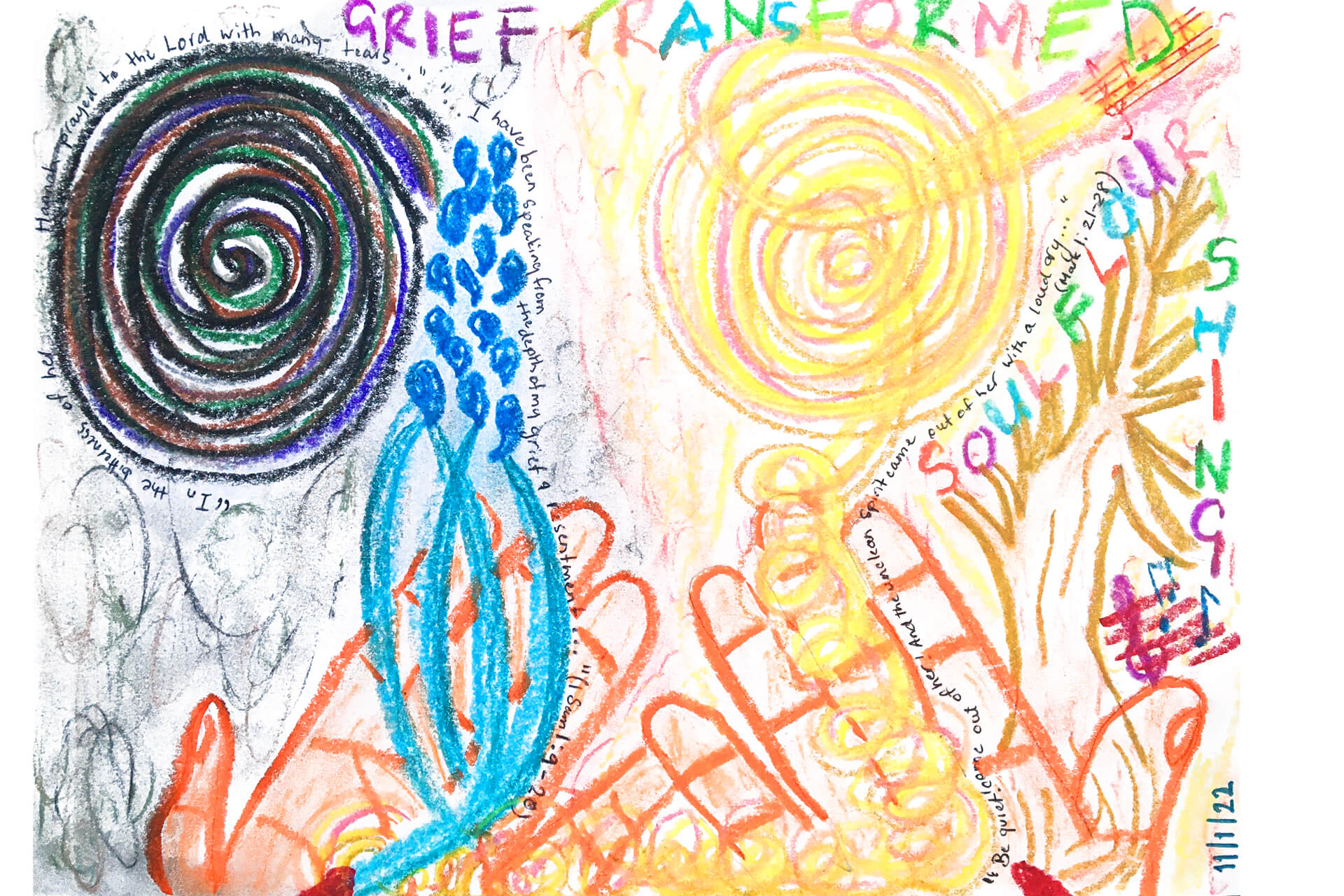
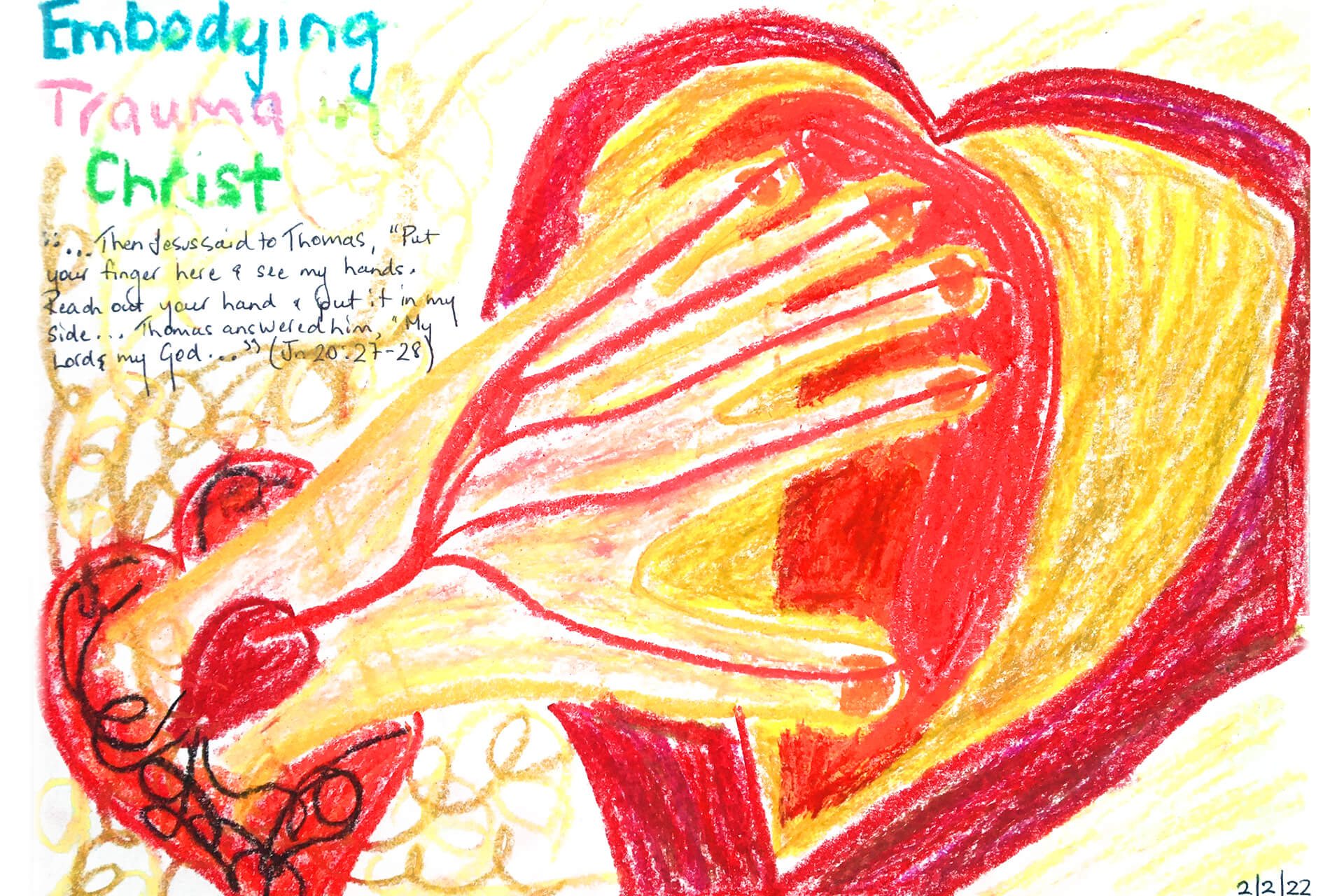
The embodied method of Tractio Divina evolved out of a personal journey of healing over three decades from child sexual abuse - including Church-related sexual abuse.
My turning point came when I hit rock bottom. I was stuck in a pit of darkness and despair. It felt to me like there was no way out. Then, in the most extraordinary way I experienced grace in all its beauty and power. I picked up my Bible, opened it up randomly, and began to read slowly and repeatedly the words from the Prophet Isaiah 43:1
But now, thus says the Lord, who created you, O Jacob, and formed you, O Israel. Fear not, for I have redeemed you. I have called you by your name: you are mine. [Is.43:1 NRSV]
I was awestruck by these words, and I sensed something inexplicable shifting within me. Like a “double-edged sword”, the words penetrated beyond my darkness and despair to the core of my true Self. It was as if God’s Word found me and spoke to me personally. Through this single event, I sensed within my whole being that I was profoundly known and loved – without even speaking a single word to God. This single encounter with God was the starting point of what has been and continues to be a life changing journey.
Later, through the grace of God, I was drawn to a community whose specific charism was Prayer and ministry of the Word of God. Within this context of ministry I began my journey of confronting trauma from childhood sexual abuse.
By engaging with the Ignatian method of Lectio Divina, I experienced how God’s Word could speak to my reality and how it bore the power to soothe, calm, and regulate my inner child in a spirit of kindness, gentleness, and compassion. As I continued to practice Lectio Divina, I experienced the enormous power God’s Word bears to transform and heal the trauma from child sexual abuse.
In recent times, I have combined my practice of Lectio Divina with the practice of praying through embodied drawing. Through my master's thesis, I came to name this method Tractio Divina. My first introduction to prayer through embodied drawing occurred in a session of spiritual accompaniment. I arrived at my session in a traumatised state. I was shut down. Blank. Mute. I had no words. As I applied the method of embodied drawing, I experienced how it provided me with a safe space for God’s grace to transform my anxiety. By the session's end, the traumatised child who fronted up to the session had been transformed to a calm and grounded woman.
My first experience of Tractio Divina was so powerful that I combined it with my daily practice of Lectio Divina. I began to experiment with this fresh practice. After completing my drawings, I would sit silently with the image and pray with it – a practice called Visio Divina. I noticed how this not only prolonged prayer but enriched it. Further, I noticed how each of these spiritual disciplines flowed so naturally from one to the other. Now, my practice of Tractio Divina combined with Lectio Divina and Visio Divina is an established part of my daily spiritual practice.
Tractio divina may be practiced on its own as a method of embodied drawing or it may be combined with other spiritual practices such as Lectio Divina (LD) and Visio Divina (VD).
The drawing below captures the dynamic process of grace that takes place within our body through the outpouring of the Holy Spirit which transforms us when it is practiced either on its own or combined with the practices of Lectio and Visio Divina.
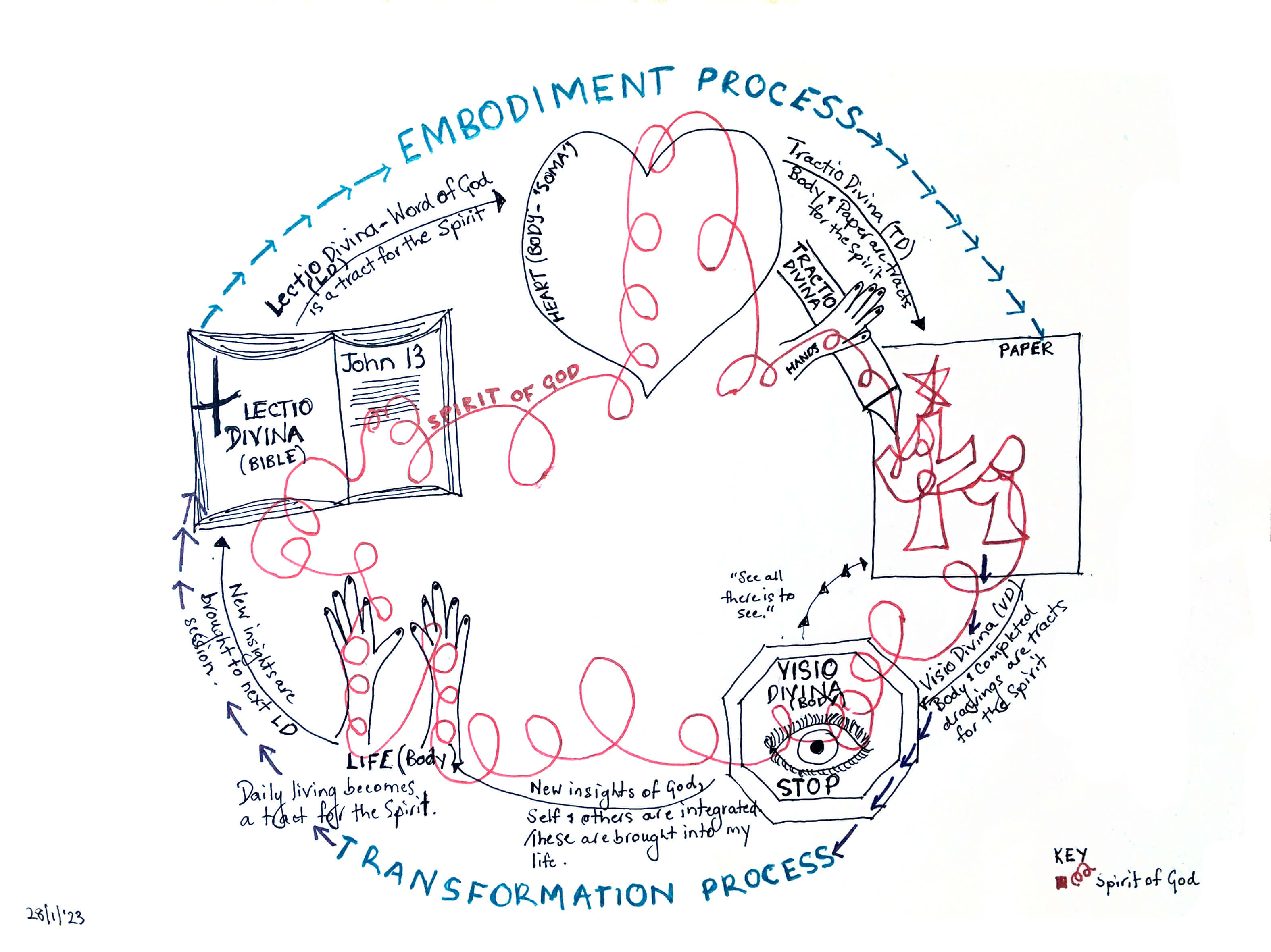
Drawing out the Relationship between Lectio Divina (LD), “Tractio Divina” (TD), and Visio Divina (VD) – Body-Spirit Based Methods, 28 January 2023, (Coloured pens on paper, 21 x 29.5 cm).
Trauma has many different definitions that are based on a diversity of perspectives from which it is considered. The word “trauma” etymologically derives from the Greek word meaning “wound.” In essence, trauma is a wound – the reason why some authors refer to “trauma” as “traumatic wounding.” The following are some author’s definition of trauma: Theologian and author, Jennifer Baldwin defines trauma as “the response to an experience/s not the event experienced.” Dr Gabor Maté similarly defines trauma as “not what happens to you, but what happens inside you as a result of what happened to you.” Bessel van der Kolk defines trauma as “an inability to inhabit one’s body without being possessed by its defences.” Finally, Peter Levine says trauma is “a highly activated incomplete biological response to threat, frozen in time.” Each of these definitions highlight that trauma occurs in the body.
Trauma is primarily a “bodily” process – its roots lie in our instinctual physiologies. Trauma is a “response” to an experience that mimics the original traumatic event. The immediate symptoms of a trauma response may include hyperarousal, constriction, dissociation, denial, feelings of helplessness, immobility, or freezing. Other symptoms, that are either affective or psychosomatic consequences of trauma, may include: hypervigilance, intrusive imagery/flashbacks, extreme sensitivity to light and sound, hyperactivity, exaggerated startle responses, night terrors, abrupt mood swings, shame, low self-worth, being easily stressed, and difficulty with sleeping. All these complex bodily symptoms of trauma may cause survivors to feel chronically unsafe inside their bodies.
Dissociation is the term that refers to leaving one’s body. It is the result of trauma survivors feeling chronically unsafe inside their body. While dissociation may make life tolerable, it comes with the high cost of losing awareness of what is going on inside the body, including the daily pleasure and comforts of human embodiment.
Interoception refers to our ability to sense the internal signals from our body, like when we are hungry, cold, or tired.
Connecting with our body through interoception is vital for knowing what is going on inside ourselves. The technical term for not being able to identify what is going on inside ourselves is alexithymia. A person suffering from alexithymia is unable to articulate what they feel about any given situation or how they themselves feel. Alexithymia is the result of numbing. It prevents a person from anticipating and responding to the needs of their body. It is critical for survivors of trauma to develop sensory awareness to learn that they can tolerate their sensations and inner experiences and create new patterns of behaviour. This is also important for learning to regulate the Central Nervous System (CNS).
Learning to regulate the CNS is key to avoid traumatisation. It requires normalizing ourselves and developing the ability to return to equilibrium and balance. If this does not happen then the CNS can be left in a dysregulated state – either a hyperaroused or shut-down (dissociated) state. This makes it impossible to function normally. Survivors of trauma may find it challenging to regulate their CNS. There is increasing research to suggest that body-based methods may benefit regulation of the CNS.
Tractio Divina may overcome the challenges of trauma and transform it in the following ways.
The practice of tractio divina – either on its own or combined with lectio divina – can empower those who are suffering with trauma to meet God in their traumatised body. Initially, this process takes place through lectio divina as the person immerses themselves within a scripture story and lives into it with their senses and imagination. It is expanded through the practice of tractio divina that allows us to draw out on paper gently and prayerfully the images and sensations that our body is holding. By engaging in this process, we can learn to safely connect with our body and God. We discover that we can tolerate and befriend the sensations in our body without being overwhelmed by them.
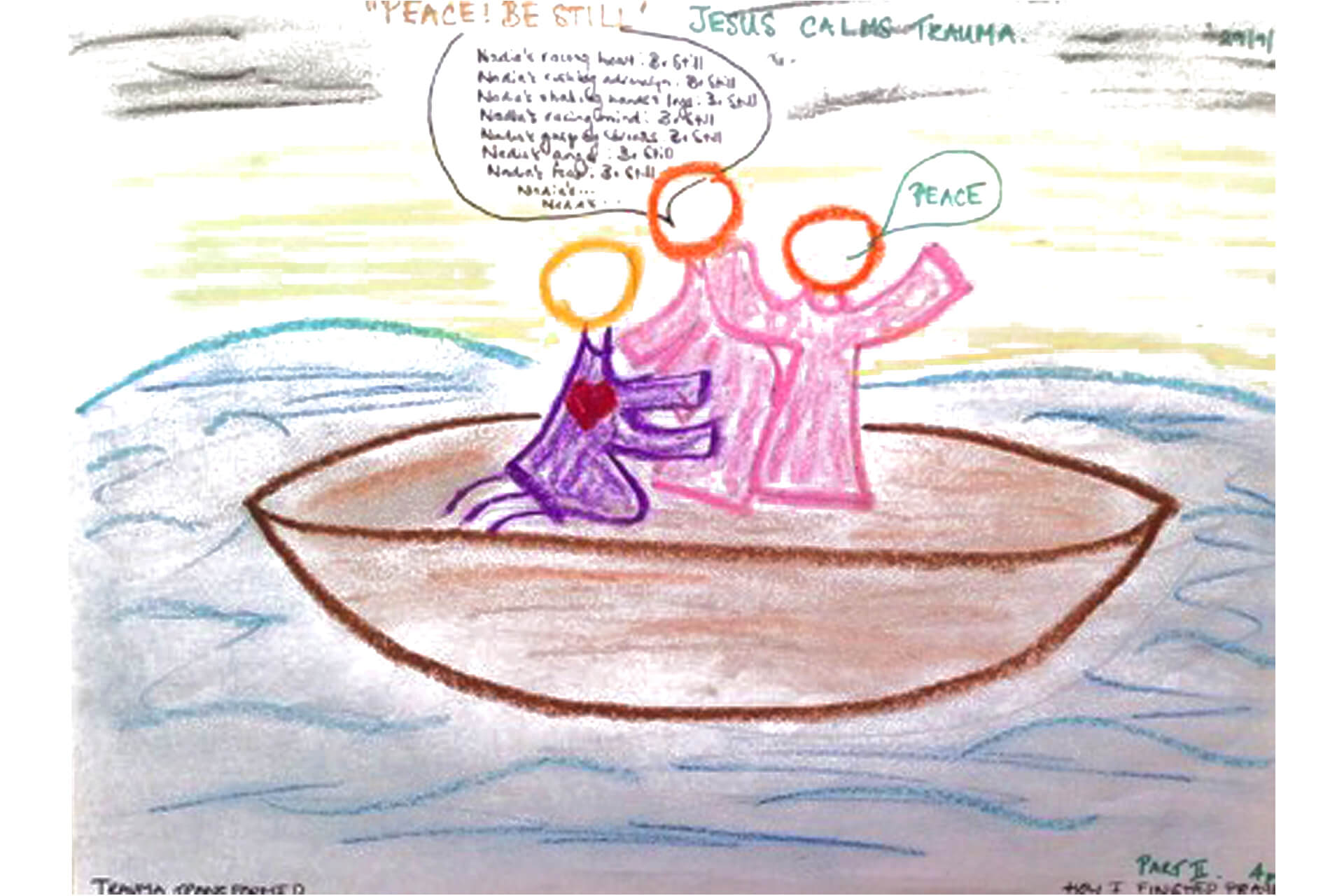
Embodiment of trauma through somatic experiencing can be terrifying for survivors and is the reason why survivors can feel unsafe inside their body. Many survivors are unable to stay in their body without being overwhelmed by the senses it experiences and the emotional numbing that shuts down all experience. The practice of tractio divina may assist us to “stay” in our traumatised body instead of dissociating which involves disconnection from parts of my body or being almost absent. As we sense and imagine what is rising up within, take hold of crayons in hand (paint brush, pencils, pens, textas, chalks, etc) and begin to draw out on paper what we are experiencing within, we are empowered to stay in our body and prayerfully engage with our trauma.
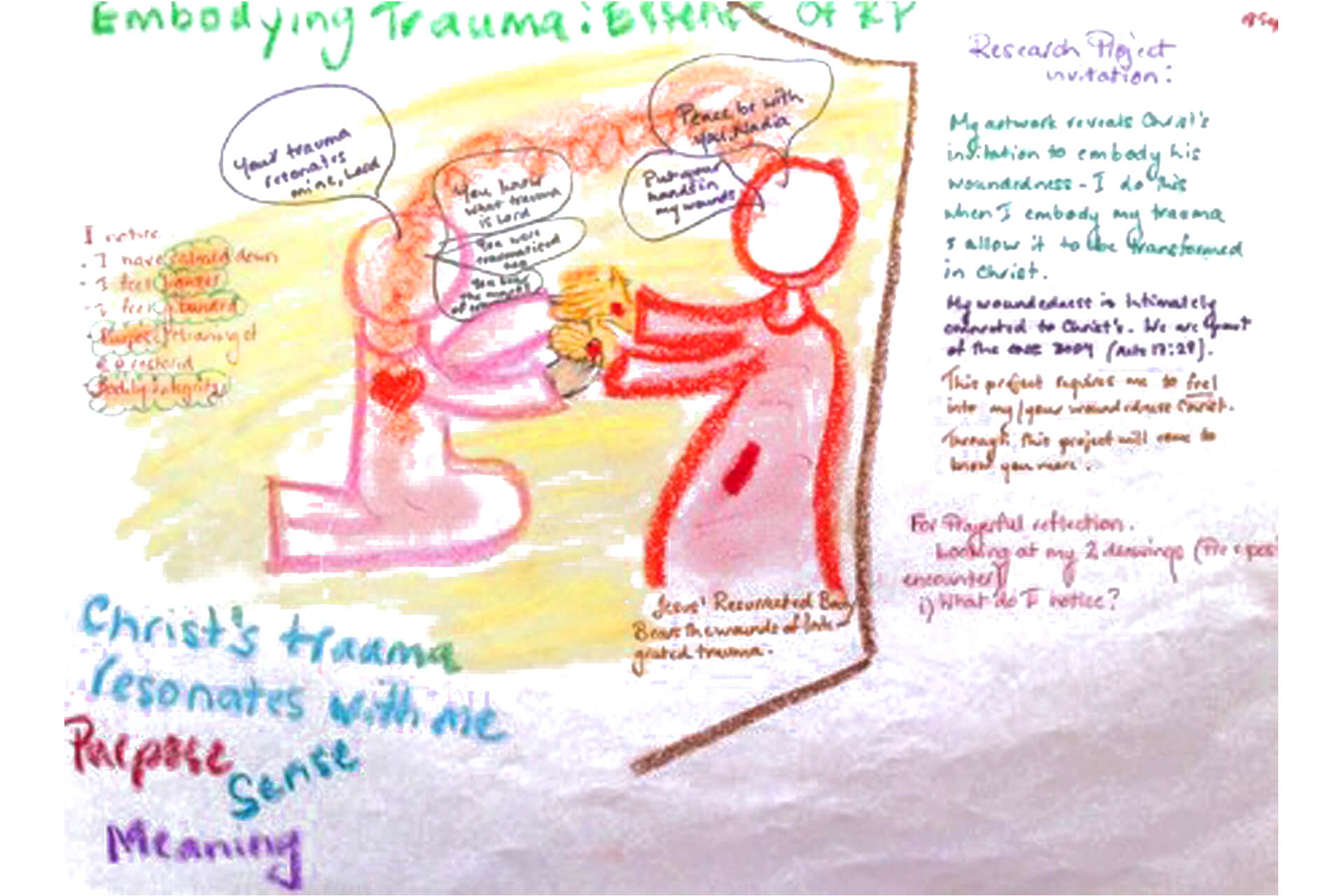
Embodying Trauma: The Core of My Research Project (Part 2 - John 20:19-23), 18 September 2021, oil crayon and chalk on paper, 29.5 x 21 cm, Sydney.
Jesus Calms a Trauma Response (Part 2 – Mark 4:35-41), 29 September 2021, oil crayon and chalk on paper, 29.5 x 21 cm, Sydney.
Dr Peter Levine's research suggests that trauma is transformed and integrated when excess frozen trauma energy is released after a “freeze” response. This can happen when we return repeatedly to the bodily sensations and bit by bit touch on the stress-associated sensations. This process is referred to as titration and enables “biological completion” by unfreezing the instinctive survival energy that was not available at the time of the traumatic event. In turn, trauma is transformed.
Tractio divina has the potential to “unfreeze” the frozen energy of trauma through a dual process of physical and spiritual traction. Physical traction is created by the adhesive connection of one’s hand gripping the crayon and moving it on paper. As this physical traction occurs, we draw out “bit by bit” on paper what is in our traumatised body. Simultaneously, a spiritual traction occurs whereby God’s grace – through the Holy Spirit - moves within me shifting what is “stuck,” loosening what is bound, and lifting-up what is crushing/burdening me. Both traction processes occurring simultaneously lead to titration as stress-associated sensations are accessed. This enables the unfreezing of “frozen trauma energy” which lends to “biological completion” and transformation of trauma. The process is further enriched through the combination of grace that flows from God’s Word and the movement of a “backwards and forwards” dialogue with God. This leads to a deeper personal knowledge of God.
Regulating the CNS means that it is normalised and returns to equilibriums and balance. This is an important factor to avoid traumatisation. Practicing tractio divina when trauma is activated can be deeply calming, soothing, and transformative. Consequently, tractio divina can return the CNS to equilibrium and balance.






To find out more information about these workshops, or to join an upcoming event please submit a “contact form” by pressing the button below for your enquiry to be answered.
Pavich, N. (2023). Tractio Divina - A Particular Christian Spritual Discipline: Exploring how it may assist Embodiment and the Transformation of Trauma. Journal of Contemporary Ministry, 8,45-66.
Child, Arise! - The Courage to Stand
Come Forward! - Bold Enough to Heal
Tractio Divina is a body-spirit based method of praying through embodied drawing. It aims to gently draw out on paper what is being sensed or experienced within one’s own body. Tractio Divina is a spiritual discipline and practice that creates a space for God’s grace to pass from within the hidden and unknown depths of our soul to without in the form of visual drawing. Unlike other spiritual practices, the starting point of tractio divina is one’s body. However, like most other spiritual practices, it too depends on rhythms of grace to gently pull up and draw-out on paper what has been covered within – we cannot force it or make it happen. It is a spiritual practice that affirms human agency and consent which is one reason why it may be particularly suitable for survivors of trauma.
The name Tractio Divina is derived from Latin. The word “tractio” in Latin means “a drawing” and it is the noun of action from the past-participle stem trahere which means "to pull, or draw,” usually along a tract. Tractio divina utilises various tracts in the process of drawing: a divine source beyond our Self, our body’s narrative, and the blank piece of paper in front of us.1 As these tracts interact with one another – our body, God, and the blank piece of paper – we gently pull up and draw out on paper what is within us while simultaneously being drawn to God/self/others. The name “tractio” resonates with the names of other Christian practices such as Lectio Divina and Visio Divina.
The embodied method of Tractio Divina evolved out of a personal journey of healing over three decades from child sexual abuse - including Church-related sexual abuse.
My turning point came when I hit rock bottom. I was stuck in a pit of darkness and despair. It felt to me like there was no way out. Then, in the most extraordinary way I experienced grace in all its beauty and power. I picked up my Bible, opened it up randomly, and began to read slowly and repeatedly the words from the Prophet Isaiah 43:1
But now, thus says the Lord, who created you, O Jacob, and formed you, O Israel. Fear not, for I have redeemed you. I have called you by your name: you are mine. [Is.43:1 NRSV]
I was awestruck by these words, and I sensed something inexplicable shifting within me. Like a “double-edged sword”, the words penetrated beyond my darkness and despair to the core of my true Self. It was as if God’s Word found me and spoke to me personally. Through this single event, I sensed within my whole being that I was profoundly known and loved – without even speaking a single word to God. This single encounter with God was the starting point of what has been and continues to be a life changing journey.
Later, through the grace of God, I was drawn to a community whose specific charism was Prayer and ministry of the Word of God. Within this context of ministry I began my journey of confronting trauma from childhood sexual abuse.
By engaging with the Ignatian method of Lectio Divina, I experienced how God’s Word could speak to my reality and how it bore the power to soothe, calm, and regulate my inner child in a spirit of kindness, gentleness, and compassion. As I continued to practice Lectio Divina, I experienced the enormous power God’s Word bears to transform and heal the trauma from child sexual abuse.
In recent times, I have combined my practice of Lectio Divina with the practice of praying through embodied drawing. Through my master's thesis, I came to name this method Tractio Divina. My first introduction to prayer through embodied drawing occurred in a session of spiritual accompaniment. I arrived at my session in a traumatised state. I was shut down. Blank. Mute. I had no words.
As I applied the mothod of embodied drawing, I experienced how it provided me with a safe space for God’s grace to transform my anxiety. By the session's end, the traumatised child who fronted up to the session had been transformed to a calm and grounded woman.
My first experience of Tractio Divina was so powerful that I combined it with my daily practice of Lectio Divina. I began to experiment with this fresh practice. After completing my drawings, I would sit silently with the image and pray with it – a practice called Visio Divina. I noticed how this not only prolonged prayer but enriched it. Further, I noticed how each of these spiritual disciplines flowed so naturally from one to the other. Now, my practice of Tractio Divina combined with Lectio Divina and Visio Divina is an established part of my daily spiritual practice.
Tractio divina may be practiced on its own as a method of embodied drawing or it may be combined with other spiritual practices such as Lectio Divina (LD) and Visio Divina (VD).
The drawing below captures the dynamic process of grace that takes place within our body through the outpouring of the Holy Spirit which transforms us when it is practiced either on its own or combined with the practices of Lectio and Visio Divina.
Drawing out the Relationship between Lectio Divina (LD), “Tractio Divina” (TD), and Visio Divina (VD) – Body-Spirit Based Methods, 28 January 2023, (Coloured pens on paper, 21 x 29.5 cm).
Tractio Divina may overcome the challenges of trauma and transform it in the following ways.
Tractio Divina workshops can be provided either online or face to face for: